
Summary: Skin whitening and skin brightening are not two phrasings of the same request. Whitening implies altering constitutive pigmentation — the genetically determined baseline set by your melanocytes — which no safe treatment does. Brightening treats facultative pigmentation, the acquired layer produced by sun, heat, hormones and inflammation, which is a legitimate and highly treatable medical problem. That distinction determines whether what you are being offered is dermatology or a health risk, and it is where a great deal of harm to Indian skin currently occurs.
Patients ask for skin whitening. Dermatologists offer skin brightening. Those sound like the same request phrased two ways, and they are not.
The distinction is not semantic caution. It is a description of two different biological targets, and it decides which treatments are appropriate and which are dangerous. I want to explain it plainly, because the gap between the two is where most pigmentation harm in Indian skin begins.
Constitutive versus facultative pigmentation
Dermatology divides skin pigmentation into two components, and almost every misunderstanding about “fairness treatments” comes from conflating them.
Constitutive pigmentation is your genetic baseline. It is determined by melanocyte activity, by the amount of eumelanin relative to pheomelanin your cells produce, and by the size and distribution of melanosomes within the keratinocytes — not by the number of melanocytes, which is broadly similar across all human skin.
This baseline is not modifiable by any safe or lawful treatment. Facultative pigmentation is everything acquired on top of that baseline in response to a stimulus: ultraviolet radiation, visible light, infrared heat, hormonal signalling, and inflammation. Tanning, melasma, post-inflammatory hyperpigmentation after acne, solar lentigines, periorbital hyperpigmentation and generalised dullness are all facultative.
All of them are treatable. When a dermatologist treats pigmentation, the target is the facultative layer and the goal is to return the skin to its own even constitutive tone. Patients frequently perceive that as having become fairer, and visually the results overlap. But the mechanism is restoration, not alteration.
This is why the honest answer to “can you make me two shades fairer” is no, while the answer to “can you clear these dark patches and even out my tone” is usually yes.
Why the whitening framing causes harm
Because a demand that legitimate medicine cannot meet does not disappear. It moves to an unregulated market.
The global market for skin lightening products is substantial and growing, with the World Health Organization citing projections of around US$11.8 billion by 2026. A significant share of that market is not dermatology at all. It is cosmetics sold on a promise that dermatology deliberately does not make.
1. Mercury
The safety consequences are documented rather than theoretical. WHO notes that inorganic mercury salts are added to some lightening products specifically because they inhibit tyrosinase, the rate-limiting enzyme in melanin synthesis, and that the Minamata Convention sets a limit of 1 part per million. A 2018 analysis found roughly 10 per cent of skin lightening creams tested exceeded that limit, some by up to 100 times.
WHO lists the resulting effects directly: skin rashes and paradoxical discolouration, scarring, damage to the nervous, digestive and immune systems, and nephrotic-range kidney damage — with particular danger to a developing fetus. Mercury-induced hyperpigmentation is itself notoriously difficult to reverse.
2. Topical corticosteroids — the more common problem in India
Mercury is the headline risk. In Indian practice, the far more common one is corticosteroid misuse.
Potent and superpotent steroids are Schedule H drugs that require a prescription, yet are widely dispensed over the counter, often in fixed-dose combination creams marketed for fairness. They produce genuine early lightening — partly by suppressing inflammation, partly by direct inhibitory effects on melanogenesis and by vasoconstriction — which is precisely why they get recommended informally and used for months.
What follows is a recognised clinical entity in Indian dermatology, topical steroid damaged face (TSDF): epidermal atrophy, telangiectasia, erythema, a persistent burning-and-stinging sensitivity, steroid-induced acneiform eruption, perioral dermatitis, hypertrichosis, and a rebound flare on withdrawal. A related and very common consequence is steroid-modified tinea — facial fungal infection whose appearance has been altered by steroid use, delaying correct diagnosis for months.
Steroid-damaged facial skin is among the harder presentations to manage, and it very often began with a patient asking for whitening and being handed something that appeared to work.
3. Intravenous glutathione and injectable “whitening” drips
Injectable glutathione for skin lightening is not an approved indication anywhere it is commonly sold. It has no adequate evidence base for altering constitutive tone, and regulators including the US FDA and India’s CDSCO have warned against unapproved injectable lightening preparations. Reported adverse effects include severe cutaneous drug reactions such as Stevens-Johnson syndrome, thyroid and renal dysfunction, and infection or sepsis from unsterile administration.
The relevant point is not that patients were careless. They asked a reasonable question, received an answer that delivered visible shortterm results, and had no way to know what it was costing them.
What legitimate treatment looks like
Treating pigmentation properly starts with diagnosis, because melasma, post-inflammatory hyperpigmentation, solar lentigines, lichen planus pigmentosus, periorbital hyperpigmentation and simple tanning can look similar to the untrained eye and respond very differently. Wood’s lamp examination and dermoscopy help establish depth and pattern before anything is prescribed.
Two cautions on the topical tier that patients rarely hear. Hydroquinone is a prescription agent, restricted in cosmetic products in several jurisdictions, and prolonged uninterrupted use carries a risk of exogenous ochronosis — a paradoxical blue-grey pigmentation that is far harder to treat than the problem it was prescribed for. It belongs in supervised cycles with defined rest periods. And any peel or active used too aggressively on Indian skin can itself trigger post-inflammatory hyperpigmentation, making the pigmentation worse.
Notice what is absent from that table. There is no step at which constitutive skin tone changes, and no treatment promising a fixed number of shades.
Where laser fits — and why the mechanism matters
Laser is an adjunct in pigmentation management, not a starting point, and in Fitzpatrick skin types IV and V the choice of device is a safety decision rather than a marketing one. The reason is that heat and inflammation are themselves pigmentary triggers: a laser that clears pigment while depositing thermal energy in the surrounding skin can lighten a patch and provoke post-inflammatory hyperpigmentation or rebound within weeks.
The science: photoacoustic, not photothermal
Older Q-switched lasers deliver energy in nanosecond pulses — billionths of a second. That is long enough for a meaningful proportion of the absorbed energy to degrade into heat and conduct outwards into surrounding tissue. Pigment is destroyed largely photothermally: in effect, it is burned.
The Candela PicoWay delivers energy in picosecond pulses — trillionths of a second, roughly a thousand times shorter. The pulse ends far faster than the melanosome’s thermal relaxation time, so the absorbed energy has no opportunity to disperse as heat. Instead it generates a rapid pressure wave that fragments the pigment particle mechanically. This is the photoacoustic, or photomechanical, effect.
The clinical consequences follow directly:
Pigment is broken into finer particles, cleared more efficiently by macrophages and the lymphatics.
Far less thermal energy reaches surrounding tissue, so the principal pigmentary trigger is largely avoided.
The risk of post-inflammatory hyperpigmentation — the characteristic hazard of laser in Indian skin — is meaningfully reduced.
Multiple wavelengths (1064 nm, 785 nm and 532 nm) allow the target depth and pigment type to be matched rather than treated with a single setting.
PicoWay is not a heat-free device, and no honest clinic will claim otherwise. But because it works predominantly photoacoustically rather than photothermally, it permits a genuinely low-thermal-load approach in exactly the skin types where thermal load causes the most trouble.
PicoWay in Thane
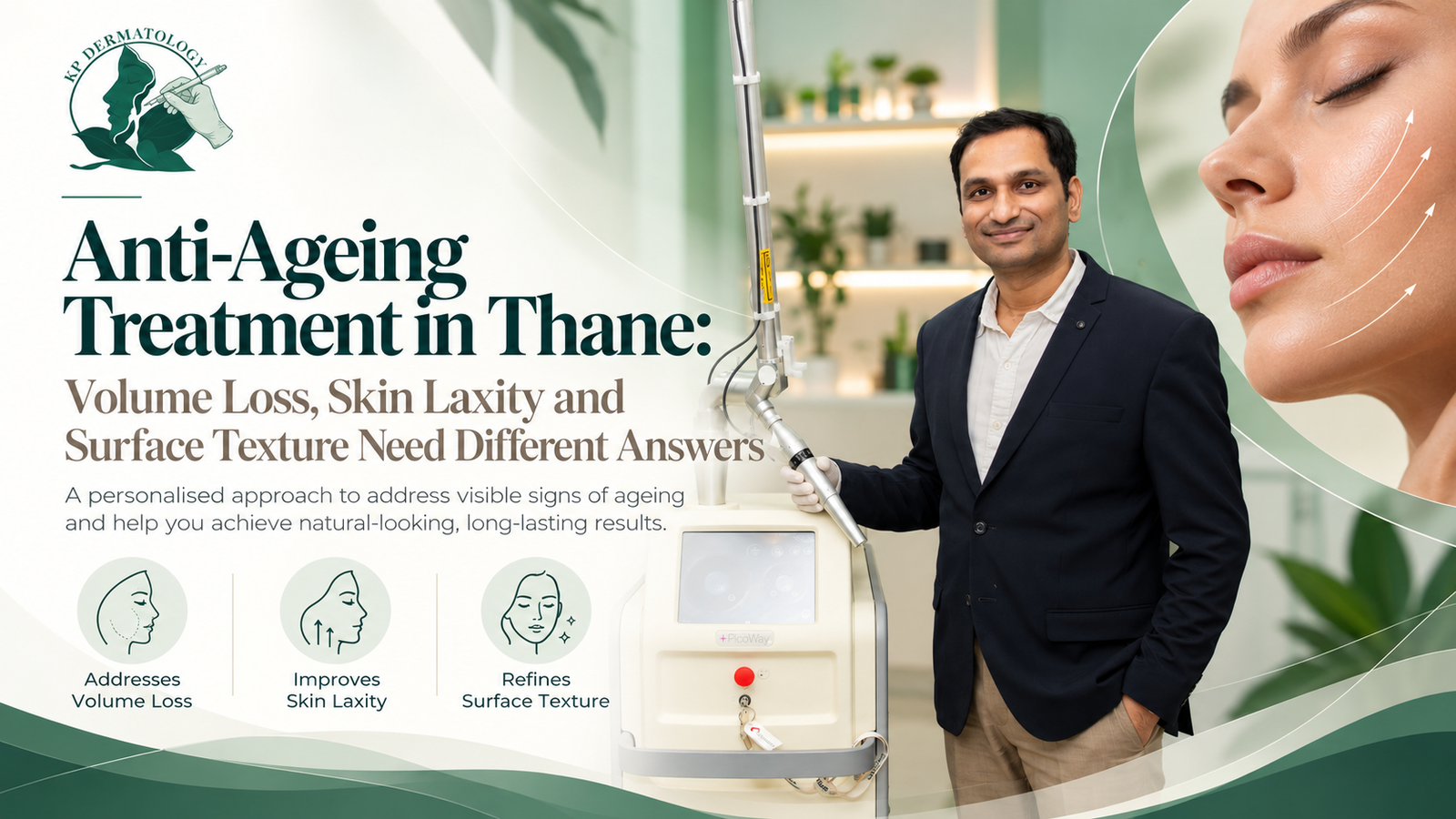
KP Dermatology is the only clinic in Thane equipped with the Candela PicoWay laser. Dr Prratyush More was the first dermatologist in Thane to introduce the technology, and every PicoWay procedure at the clinic is performed by Dr More himself — not delegated to a technician or assistant.
That matters here more than the brand name does. Fluence, spot size, wavelength and treatment endpoint are judged patient by patient and session by session, and pigmentation in Indian skin is unforgiving of a settings-by-protocol approach. Laser is offered only where it genuinely adds value, and always alongside photoprotection and topical therapy rather than in place of them.
No laser changes your constitutive skin tone. A picosecond laser clears acquired pigment more selectively and with less thermal collateral than older devices — that is a real clinical advantage, and it is a different claim from “fairness”.
Frequently asked questions
Can any treatment permanently make my skin fairer than my natural tone?
No. Constitutive pigmentation is genetically determined and no safe treatment alters it. What can be treated is the acquired pigmentation sitting on top of it — and clearing that often produces a visibly brighter, more even complexion.
Is skin brightening safe for Indian skin?
Yes, when it is prescribed and supervised. Indian skin carries a higher risk of post-inflammatory hyperpigmentation, which is why treatment is layered gradually and why aggressive peels or high-fluence laser are avoided. The risk lies in unregulated products, not in dermatological treatment.
What is the difference between photoacoustic and photothermal laser treatment?
A photothermal laser destroys pigment by heating it; a photoacoustic laser shatters it with a rapid pressure wave generated by an ultrashort pulse. Because PicoWay’s picosecond pulses end before heat can spread from the pigment particle, its mechanism is predominantly photoacoustic and far less heat reaches surrounding skin — which lowers the risk of rebound pigmentation in darker skin types.
Are over-the-counter fairness creams safe?
Many are not. Independent testing has repeatedly found undeclared mercury and potent corticosteroids in such products. If a cream produces rapid lightening within days to weeks, that is a reason for suspicion rather than reassurance. Bring the product to your consultation — identifying it matters to the treatment plan.
I have used a steroid cream on my face for months. What now?
Stop only under supervision, because abrupt withdrawal typically causes a rebound flare. Topical steroid damaged face is treatable, but recovery is gradual and requires a structured taper, barrier repair, strict photoprotection, and treatment of any secondary infection. Do not start any brightening agent until the skin has settled.
Are glutathione injections or IV drips effective?
They are not an approved treatment for skin lightening, lack adequate evidence, and carry documented risks including severe drug reactions and complications from unsterile administration. We do not offer them.
Why clinics should say this out loud
There is commercial pressure not to. “Skin brightening” sells more comfortably than “we will not do that.”
But the reputational cost of overpromising lands on the whole specialty. Every patient who spends a year on unregulated creams before arriving with steroid damage arrives with less trust in dermatology generally, and a harder problem to fix. Naming the distinction clearly at the first consultation does more for patient safety than any amount of aftercare. It reframes the goal from an unachievable target to an achievable one — and achievable goals are the ones patients stay with long enough to see results.
How we handle this at KP Dermatology
Because the request patients arrive with and the treatment they actually need are often different things, we would rather have that conversation openly at the start than deliver something we cannot stand behind.
At KP Dermatology in Thane, pigmentation is diagnosed before it is treated, patients are told plainly what is and is not achievable for their skin, and treatment is built around evening tone and addressing the underlying condition rather than altering baseline colour. Dr Prratyush More brings over fourteen years of clinical experience and advanced international laser training, was the first dermatologist in Thane to introduce Candela PicoWay, and the clinic remains the only one in Thane with the technology. Every PicoWay procedure is performed by Dr More personally, on protocols calibrated for Indian skin.
Book a consultation
Indian skin does not need to be lightened. It very often does need pigmentation treated, sun damage reversed and tone evened out — and those are genuine medical goals with genuine, safe treatments behind them. If you have been fighting pigmentation with products that promise a shade card, book a consultation at KP Dermatology, Thane, and find out what is actually treatable.
References
1. World Health Organization. Mercury in skin lightening products — information sheet.
2. United Nations Environment Programme. Minamata Convention on Mercury.
3. Indian Association of Dermatologists, Venereologists and Leprologists (IADVL) Task Force Against Topical Steroid Abuse. Position statements on topical corticosteroid misuse in India.
4. Coondoo A, Phiske M, Verma S, Lahiri K. Side-effects of topical steroids: a long overdue revisit. Indian Dermatology Online Journal.
5. Sonthalia S, Daulatabad D, Sarkar R. Glutathione as a skin whitening agent: facts, myths, evidence and controversies. Indian Journal of Dermatology, Venereology and Leprology.
6. Mahmoud BH, et al. Impact of long-wavelength visible light on melanocompetent skin. Journal of Investigative Dermatology.
7. Anderson RR, Parrish JA. Selective photothermolysis: precise microsurgery by selective absorption of pulsed radiation. Science.
8. Torbeck RL, Schilling L, Khorasani H, et al. Evolution of the picosecond laser: a review of literature. Dermatologic Surgery.
This article is intended for general education and does not constitute individual medical advice. Pigmentation requires assessment by a qualified dermatologist before any treatment is started. Individual results vary and no outcome is guaranteed. Prescription topical and oral therapies mentioned here should be used only under dermatological supervision. Do not stop a long-term topical steroid without medical advice.