
MEDICALLY REVIEWED BY DR PRRATYUSH MORE, MBBS, DDVL — CONSULTANT DERMATOLOGIST, KP DERMATOLOGY, THANE
Summary: Melasma is a chronic pigmentation disorder producing symmetrical brown to greyish patches across the cheeks, forehead and upper lip. It is driven by ultraviolet and visible light, heat, hormones and genetic predisposition, which is why it relapses so readily. Melasma is managed rather than cured. The most effective approach layers strict broad-spectrum sun protection with dermatologist-prescribed topical therapy, and adds low-fluence picosecond laser only where it is genuinely warranted. Treating melasma aggressively is the single most common reason it gets worse.
If your melasma has faded and returned more than once, you have not failed at treatment. You have encountered the nature of the condition.
Melasma is genuinely chronic. It responds well, then relapses when the trigger returns, and the patients who do best are the ones who understand this from the start rather than chasing a permanent cure. This guide explains why melasma comes back, what actually keeps it under control, and precisely where laser fits into a sensible, evidence-led plan.
What is melasma?
Melasma is a chronic, acquired disorder of hyperpigmentation that produces symmetrical brown to greyish-brown patches, most often on the cheeks, forehead, upper lip and bridge of the nose. It develops when melanocytes — the pigment-producing cells of the epidermis — become hyperfunctional in response to ultraviolet light, visible light, heat and hormonal signalling.
Modern dermatological understanding has moved well beyond “overactive pigment cells”. Melasma is now recognised as a condition involving the whole skin unit: an altered basement membrane, increased dermal vascularity, mast cell infiltration, and photoageing of the surrounding dermis all contribute. This is why melasma behaves so differently from ordinary sun spots, and why it resists the treatments that clear them.
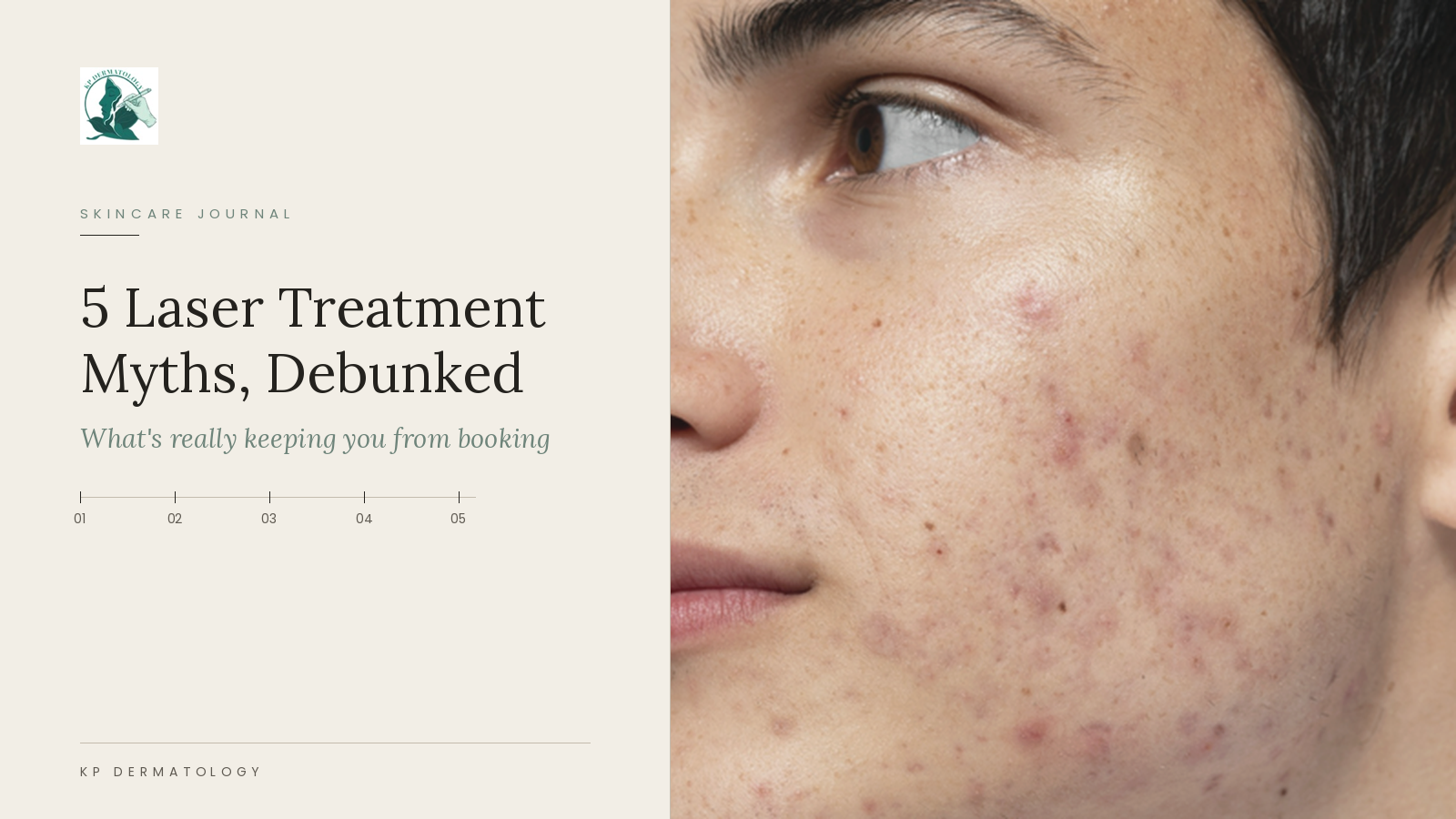
The symmetry is the giveaway. Unlike solar lentigines or post-inflammatory hyperpigmentation, melasma appears in a mirrored pattern across both sides of the face. In a large multicentre Indian study of 331 patients, the two dominant patterns were centrofacial at 42 per cent and malar at 39 per cent. That same study reported a female-to-male ratio of roughly 4:1 with a mean age of 37 years — though men do develop melasma and are frequently misdiagnosed.
Epidermal, dermal and mixed melasma
Depth matters, because it predicts how the pigment will respond. Epidermal melasma sits superficially and lightens most readily. Dermal melasma involves pigment-laden macrophages deeper in the skin and responds slowly and incompletely. Mixed melasma, the most common presentation in Indian skin, contains both. Assessment under Wood’s lamp or dermoscopy before treatment is not a formality — it changes the plan.
Why does melasma keep coming back?
Melasma relapses because its triggers — ultraviolet radiation, visible light, infrared heat and hormones — are features of ordinary daily life rather than one-off events. Treatment suppresses melanogenesis; it does not remove the underlying tendency of those melanocytes to overproduce. Pigment therefore returns whenever exposure resumes. This is precisely why dermatologists describe melasma as controlled rather than cured. The Indian Pigmentary Expert Group’s consensus review states plainly that melasma is a persistent disorder of pigmentation in which relapse after initial improvement is common, and recommends long-term maintenance therapy rather than a fixed course of treatment.
The common triggers behind a relapse
Ultraviolet radiation: the single biggest driver, including brief daily exposure such as a commute.
Visible light, particularly high-energy blue light: ordinary daylight and screens can induce pigmentation in darker skin types even in the complete absence of UV. Most clear chemical sunscreens do not block it.
Infrared heat: cooking over a flame, sun-facing travel and Mumbai’s climate stimulate melanogenesis independently of light.
Hormonal influence: pregnancy, combined oral contraceptives, hormonal IUDs and thyroid dysfunction.
Aggressive treatment: harsh peels, physical scrubs, ablative resurfacing and high-fluence laser inflame the skin and provoke post-inflammatory hyperpigmentation on top of the melasma.
That last point deserves emphasis. Melasma is an unusually easy condition to make worse, and a substantial proportion of the “resistant” melasma seen in clinic has been aggravated by over-treatment elsewhere.
What actually controls melasma?
The foundation is daily broad-spectrum photoprotection, layered with dermatologist-prescribed topical therapy. Procedures such as superficial peels and low-fluence picosecond laser are second- and third-line support, never the starting point. Consistency matters far more than intensity, because melasma responds to sustained suppression rather than aggressive intervention.
|
Tier |
What it involves |
Role |
|
1. Photoprotection |
Broad-spectrum tinted SPF 50+ with iron oxides, reapplied through the day; hats and shade; heat avoidance |
Non-negotiable foundation |
|
2. Topical therapy |
Prescribed depigmenting agents — hydroquinone or modified Kligman- type combinations used in cycles, azelaic acid, cysteamine, niacinamide, topical tranexamic acid, retinoids |
Primary active treatment |
|
3. Systemic therapy |
Oral tranexamic acid in selected patients, after screening for thrombotic risk |
Adjunct, dermatologist- supervised |
|
4. Procedures |
Superficial chemical peels; low-fluence picosecond laser (PicoWay) |
Adjunct, only once tiers 1–2 are established |
Sun protection is where most patients quietly fall short. The same Indian cohort found that only 35 per cent of melasma patients were using any sunscreen at all, and just 10 per cent of those used an SPF above 50. Tinted formulations matter particularly: the iron oxides in them absorb visible light that clear sunscreens transmit almost entirely.
A tinted SPF 50 used every single day and reapplied will outperform any procedure done occasionally. This is the least glamorous sentence in this article and the most important one.
Where does laser fit in melasma treatment?
Laser is an adjunct for melasma, not a first-line treatment. Used correctly, on low-fluence picosecond settings, it can help lighten resistant patches without generating the thermal load that triggers a flare. Used aggressively, it reliably makes melasma worse. The technology matters considerably less than the settings and the clinical judgement behind them — but the technology does set the ceiling on how gently the job can be done. This is where melasma differs from every other pigmentation problem. With a solar lentigo, more energy clears pigment faster. With melasma, heat is itself a trigger, so a device that clears pigment while heating the surrounding tissue can lighten a patch and provoke rebound pigmentation within weeks.
The science: photoacoustic, not photothermal
The science: photoacoustic, not photothermal This distinction is the entire basis of the melasma protocol, and it is worth understanding properly. Older Q-switched lasers deliver energy in nanosecond pulses — billionths of a second. That is long enough for a meaningful proportion of the absorbed energy to degrade into heat and conduct outwards into the surrounding dermis. The pigment is destroyed largely photothermally: it is, in effect, burned.
PicoWay delivers energy in picosecond pulses — trillionths of a second, roughly a thousand times shorter. The pulse is delivered far faster than the melanosome’s thermal relaxation time, so the energy has no opportunity to disperse as heat. Instead it generates a rapid pressure wave that shatters the pigment particle mechanically. This is the photoacoustic (photomechanical) effect.
The clinical consequences follow directly:
- Pigment is fragmented into finer particles, which are cleared more efficiently by the immune system.
- Far less thermal energy is deposited in the surrounding tissue, so the principal melasma trigger is largely avoided.
- The risk of post-inflammatory hyperpigmentation — the characteristic hazard of laser in Fitzpatrick skin types IV and V — is meaningfully reduced.
PicoWay is not a heat-free device, and no honest clinic will tell you otherwise. But because it works predominantly photoacoustically rather than photothermally, it allows a genuinely low-thermal-load approach to a condition in which heat is the enemy.
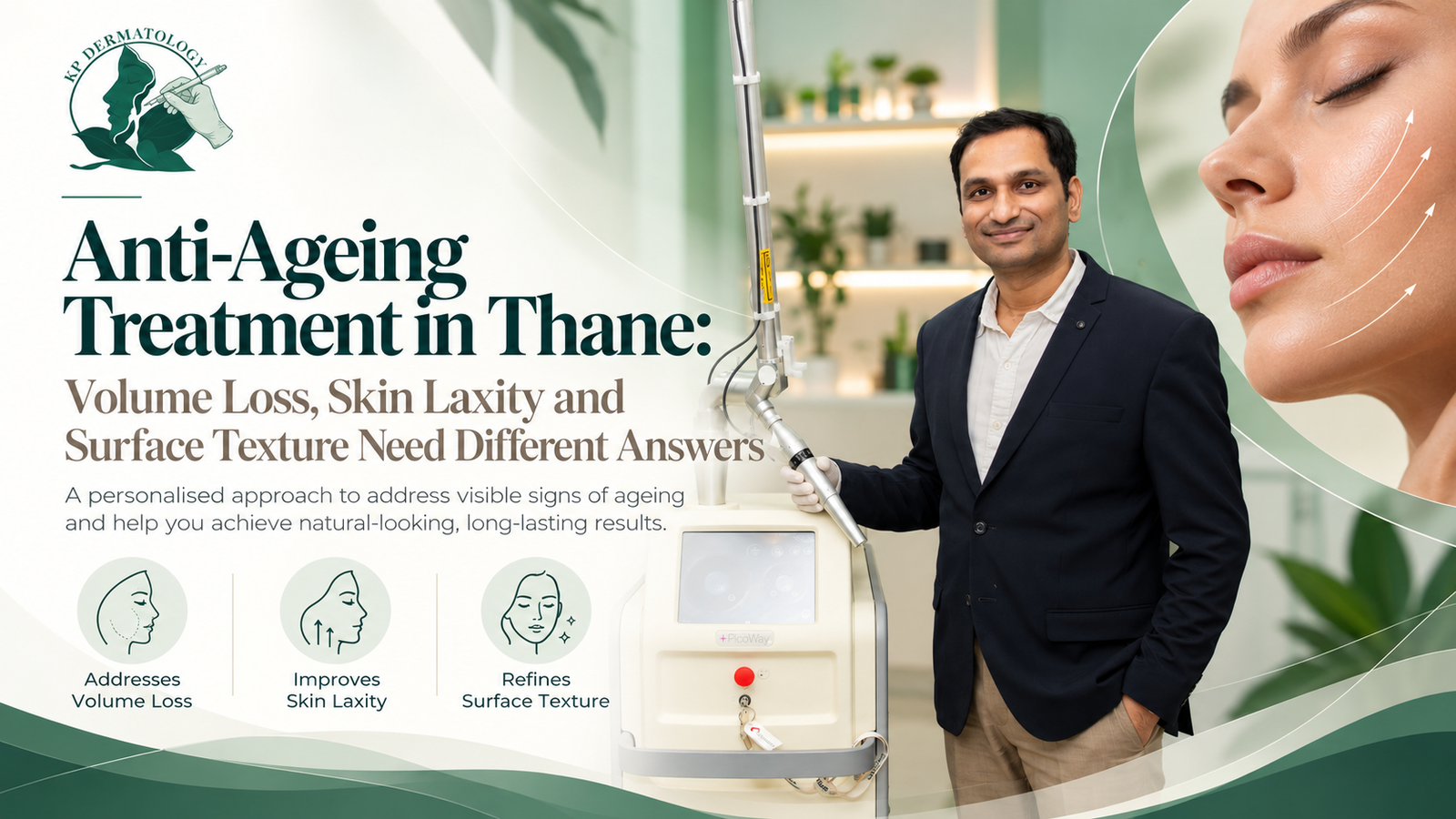
KP Dermatology is the only clinic in Thane equipped with the Candela PicoWay laser. Dr Prratyush More was the first dermatologist in Thane to introduce the technology, and every PicoWay procedure at the clinic is performed by Dr More personally — not delegated to a technician or an assistant.That matters more in melasma than in almost any other indication. Fluence, spot size, wavelength selection and endpoint are judged patch by patch and session by session; melasma is unforgiving of a settings-by-protocol approach. The 1064 nm wavelength is used at deliberately low fluence for melasma, with treatment endpoints chosen to avoid any visible thermal reaction.
Laser is added only once photoprotection and topical therapy are established, and only for patients whose melasma genuinely warrants it. Sessions are planned individually and framed as ongoing management, not a fixed course of six.
Anyone promising to clear melasma permanently in a set number of laser sessions is describing a condition other than melasma.
How long does melasma treatment take?
Expect gradual lightening over weeks to months rather than a rapid change. Topical therapy typically shows visible improvement by eight to twelve weeks, and laser results build progressively across sessions. Maintenance then continues indefinitely, because discontinuing photoprotection and topical treatment is what permits relapse.
Patience is genuinely part of the treatment. Melasma sits deeper and behaves more stubbornly than most pigmentation, and the Indian cohort found that around 43 per cent of patients had been living with it for more than three years before it was properly assessed. Rapid results are not a realistic goal, and the treatments that promise them are usually the ones that cause rebound.
A realistic plan looks like steady improvement across three to six months, followed by long-term maintenance that holds the result there.
Frequently asked questions
Can melasma be cured permanently?
No. Melasma is a chronic condition that is managed rather than cured, because its triggers are ongoing. With consistent photoprotection and maintenance treatment it can be kept very well controlled, but stopping treatment or sun protection usually allows it to return.
Does laser make melasma worse?
It can, if the wrong device or settings are used. Heat is a melasma trigger, so high-fluence laser frequently causes rebound pigmentation. Low-fluence picosecond protocols, which act photoacoustically rather than photothermally and are applied conservatively by a dermatologist, are considerably safer — and are still used as an adjunct rather than a first treatment.
What is the difference between photoacoustic and photothermal laser treatment?
A photothermal laser destroys pigment by heating it; a photoacoustic laser shatters pigment with a rapid pressure wave generated by an ultra-short pulse. Because PicoWay’s picosecond pulses are shorter than the time it takes heat to spread from the pigment particle, the mechanism is predominantly photoacoustic and far less heat reaches the surrounding skin. In melasma, where heat is itself a trigger, that difference is clinically significant.
Is melasma the same as ordinary pigmentation?
No. Melasma is symmetrical, hormonally influenced and sits deeper than sun spots or post-acne marks. It relapses far more readily and needs a gentler, longer-term approach, which is why accurate diagnosis before treatment genuinely matters.
Can men get melasma?
Yes. Roughly one in five melasma patients is male, and it is often missed or mistaken for tanning. The triggers and the treatment are the same, though men are typically diagnosed later because the condition is assumed to affect only women.
Will sunscreen alone fix melasma?
Sunscreen alone will not clear established melasma, but no treatment works reliably without it. Broad-spectrum SPF 50+, ideally tinted to block visible light, both prevents relapse and improves the results of every other treatment used alongside it.
Why choose KP Dermatology for melasma treatment in Thane ?
Because melasma is so easily worsened by over-treatment, it needs a dermatologist willing to hold back as readily as intervene. That is where the clinic differs.
Dr Prratyush More brings over fourteen years of clinical experience and advanced international laser training. He was the first dermatologist in Thane to introduce Candela PicoWay, and KP Dermatology remains the only clinic in Thane with the technology. Melasma patients are assessed properly, started on photoprotection and topical therapy first, and offered pigmentation laser only where it genuinely adds value — on low-fluence protocols calibrated for Indian skin. Every PicoWay procedure is performed by Dr More himself.
That measured, medical approach is what makes the clinic a trusted choice for pigmentation treatment in Thane.
Book a consultation
Melasma is frustrating precisely because it responds and returns — but it is very manageable once treated as the chronic condition it is. Consistency beats intensity every time. If your melasma has been coming back, book a consultation at KP Dermatology, Thane, for an honest assessment and a plan built to hold.
References
1. Sarkar R, et al. Melasma in Indian patients: a multicentre clinico-epidemiological study. Indian Journal of Dermatology, Venereology and Leprology.
2. Indian Pigmentary Expert Group. Consensus recommendations on the management of melasma in Indian patients.
3. Mahmoud BH, et al. Impact of long-wavelength visible light on melanocompetent skin. Journal of Investigative Dermatology.
4. Kwon SH, Na JI, Choi JY, Park KC. Melasma: updates and perspectives on pathogenesis. Experimental Dermatology.
5. Torbeck RL, Schilling L, Khorasani H, et al. Evolution of the picosecond laser: a review of literature. Dermatologic Surgery.
6. Anderson RR, Parrish JA. Selective photothermolysis: precise microsurgery by selective absorption of pulsed radiation. Science.
This article is intended for general education and does not constitute individual medical advice. Melasma requires assessment by a qualified dermatologist before any treatment is started. Individual results vary; no outcome is guaranteed. Prescription topical and oral therapies mentioned here should be used only under dermatological supervision.